Tag: artificial-intelligence

  • LG Unveils Korea’s First Hybrid AI Model ‘EXAONE 4.0’—Outperforming Global Giants

    LG AI Research has introduced “EXAONE 4.0,” Korea’s first hybrid AI model, positioning itself alongside top players like Anthropic and Alibaba in the global AI race. The announcement was made on July 15, ahead of the company’s upcoming “LG AI Talk Concert 2025” to be held on July 22 at LG Science Park in Seoul.

    EXAONE 4.0 uniquely combines two core AI capabilities: natural language understanding and generation powered by a large language model, and autonomous reasoning for problem-solving. It can not only respond quickly to knowledge-based queries but also hypothesize, verify, and explain complex ideas—essentially thinking like a human expert.

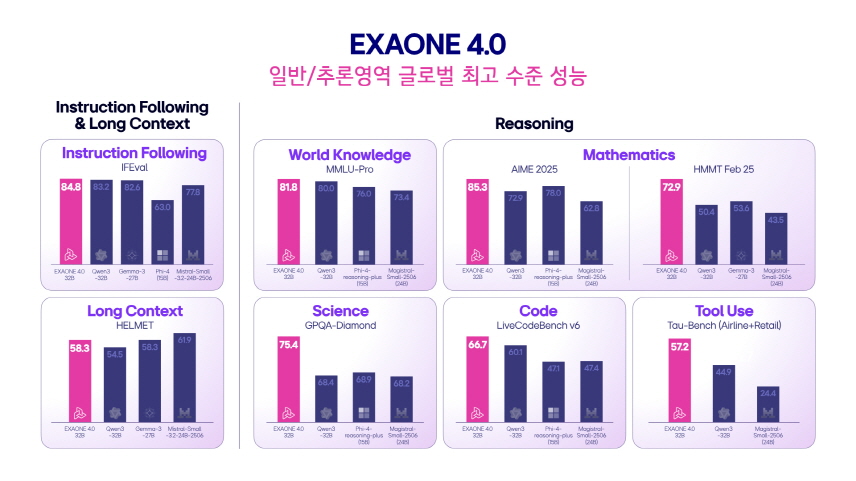
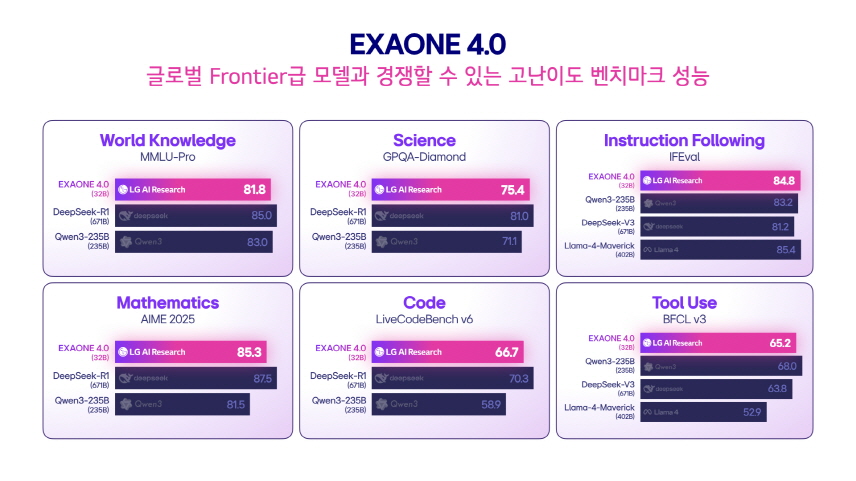
    LG’s new model achieved best-in-class results in multiple benchmark tests. It scored 92.3 and 81.8 in MMLU-Redux and MMLU-Pro (measuring knowledge and reasoning), outperformed rivals in coding (66.7 in LiveCodeBench v6), science (75.4 in GPQA-Diamond), and mathematics (85.3 in AIME 2025)—surpassing open models from Google, Meta, Microsoft, Alibaba, and Mistral.

    To ensure broad accessibility, LG has released EXAONE 4.0 as an open-weight model on Hugging Face, allowing the global research community to experiment and build on it.
    A Model with Real Expertise—Not Just Language Fluency

    EXAONE 4.0 comes in two variants: a 32-billion-parameter expert model and a 1.2-billion-parameter on-device model. The expert version passed six Korean national licensing exams, including for medical doctors and appraisers, demonstrating its practical depth and domain knowledge.

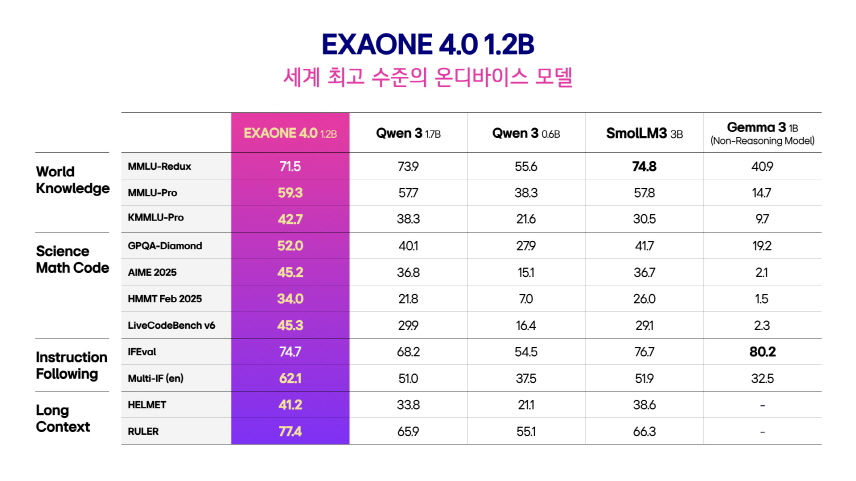
    The on-device model is optimized for edge devices like smartphones, home appliances, and vehicles. Despite its compact size, it surpasses OpenAI’s GPT-4o mini in key areas such as math, coding, and science, making it a strong contender in the emerging on-device AI market.
    EXAONE Now Available via API

    LG has partnered with Friendly AI to launch a commercial API for EXAONE 4.0. Developers and businesses can now access the model without high-end GPUs, making it easier to integrate powerful AI into everyday services.

    Earlier this year, LG Corp. CEO Koo Kwang-mo emphasized the company’s vision: “By making advanced technologies like AI accessible in daily life, we aim to create a new lifestyle where people can spend their time on more joyful and meaningful pursuits.”

    With EXAONE 4.0, LG not only delivers a technological leap but also signals its determination to lead in the global AI ecosystem—on devices, in research labs, and across industries.
  • SolidVue and Lumotive sign partnership to co-develop next-generation LiDAR

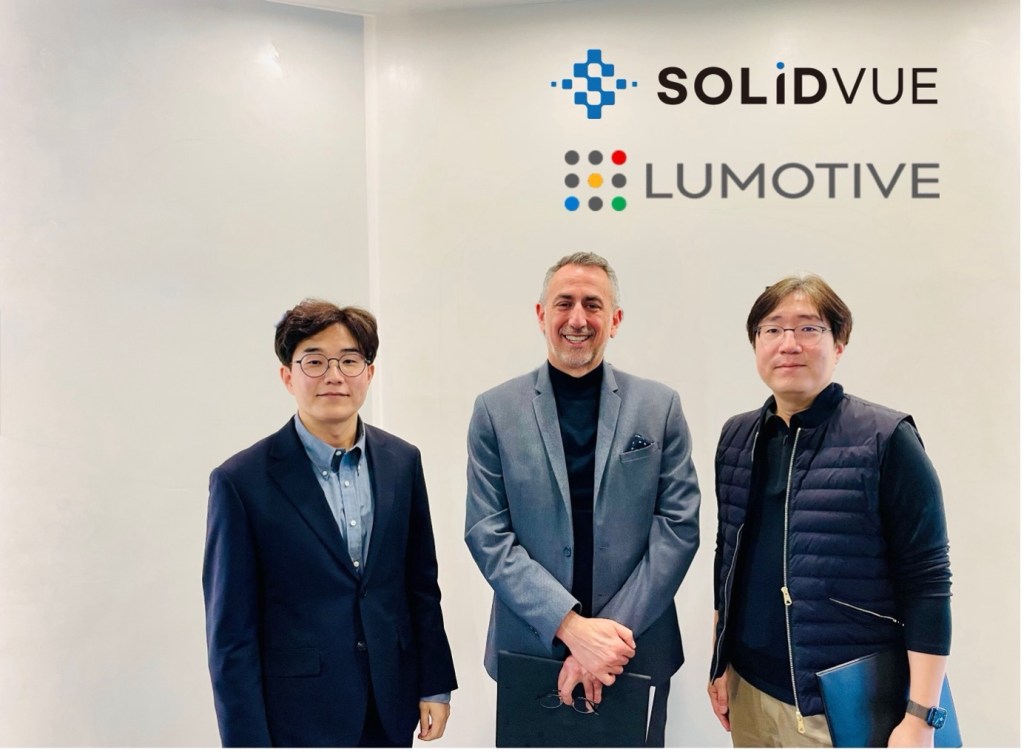
    From left: Jung-Hoon Chun, Co-CEO of SolidVue; Sam Heidari, CEO of Lumotive; and Jaehyuk Choi, Co-CEO of SolidVue, pose for a photo to commemorate the signing of a joint development agreement for next-generation LiDAR systems | Photo provided by SolidVue

    SolidVue, a leading developer of SPAD sensor ICs, has entered into a strategic partnership with U.S.-based programmable photonics company Lumotive to co-develop next-generation LiDAR systems. The two companies plan to set new standards in the 3D sensing industry by leveraging their respective core technologies.

    At the heart of the collaboration is the integration of SolidVue’s high-performance dTOF SPAD sensor—responsible for light detection—with Lumotive’s Light Control Metasurface (LCM™) beam steering technology, which handles light projection. The goal is to jointly develop a reference design that can become the standard for next-generation LiDAR systems. This integrated approach is expected to enable high-resolution, high-precision, and energy-efficient LiDAR solutions applicable to autonomous driving, industrial automation, and smart devices.

    The partnership reflects the shared vision of both companies to accelerate the adoption of compact, cost-effective, high-performance LiDAR solutions across key markets such as autonomous vehicles, industrial automation, and smart consumer electronics.

    “We aim to expand the potential of LiDAR systems by combining our high-performance SPAD technology with Lumotive’s innovative beam steering technology,” said Jung-Hoon Chun, Co-CEO of SolidVue. “This collaboration is a major milestone toward realizing SolidVue’s vision of delivering high-resolution and highly reliable LiDAR sensor ICs to the global market.”

    “By combining SolidVue’s cutting-edge sensor technology with our LCM™ technology, we’re setting a new benchmark in LiDAR performance and opening doors for next-generation applications,” said Sam Heidari, CEO of Lumotive. “This partnership, where our visions and technologies align, is expected to have a profound impact across multiple industries.”

    SolidVue and Lumotive will continue their collaboration to introduce a new class of LiDAR solutions to the market that offer high performance, scalability, and design flexibility, each building on their respective technological strengths.

    SolidVue is a technology company specializing in the development of advanced LiDAR sensor ICs. It leads in CMOS SPAD (Single Photon Avalanche Diode) technology, which enables high-precision 3D imaging. The company develops compact, energy-efficient LiDAR sensor solutions applicable to autonomous driving, AR/VR, and smart devices, while maintaining cost-efficiency.

  • DALBOT commercializes AI-powered garlic top remover robot

    A new AI-powered robotic device that removes garlic tops has emerged, promising to greatly enhance the taste and quality of garlic-processed foods.

    DALBOT (CEO Junggeun Kang), a food-tech company based in Dalseong, Daegu, announced on the 10th the launch of its garlic top remover robot that removes the stem-like tops of garlic.

    This system uses AI vision inspection technology to scan an average of 300 kg of peeled garlic per day, automatically removing defective pieces and trimming off the top parts. When multiple garlic top remover units are installed in a modular setup, they can be combined with a conveyor to handle high-volume garlic processing tasks.

    Garlic Top Remover Robot cutting only the top part of garlic | Photo provided by DALBOT

    Garlic tops are coarse and tough, making them undesirable as food ingredients. However, removing them requires labor-intensive manual work, so most garlic products on the market still contain these tops. DALBOT stated that the robot can replace the work of three human laborers, making it a significant support for garlic farms and food companies struggling with labor shortages due to aging rural populations.

    Garlic with the top removed has a superior texture and sells for 20 to 50 percent more than regular garlic, but limited labor availability restricts supply. Mass-producing top-removed garlic with the robot could enhance the flavor of traditional foods like kimchi and seasoning sauces. It may also lead to the development of new garlic-based food products, boosting both domestic and international garlic industries.

    Garlic Top Remover Robot main body | Photo provided by DALBOT

    “The traditional field of agricultural processing can be revolutionized by integrating AI,” said DALBOT CEO Junggeun Kang. “With the garlic top remover robot, we aim to create a mutually beneficial model for the food industry.”

    In addition to garlic processing, DALBOT is developing a diverse portfolio of food-tech robots for applications such as fish cake production and strawberry processing, launching them both domestically and abroad.

    DALBOT specializes in image processing and AI-based robotics. Leveraging 30 years of accumulated robotics technology and AI development experience, the company provides optimized production automation solutions for agricultural product processing. It aims to bridge the gap between the growing demand for processed agri-food products and rural labor shortages with intelligent automation solutions.