Tag: south-korea

  • Unification Church Paid Pence $550,000 to Visit Korea, Arranged Meeting with Yoon Suk-yeol

    Photo courtsey of People’s Power Party

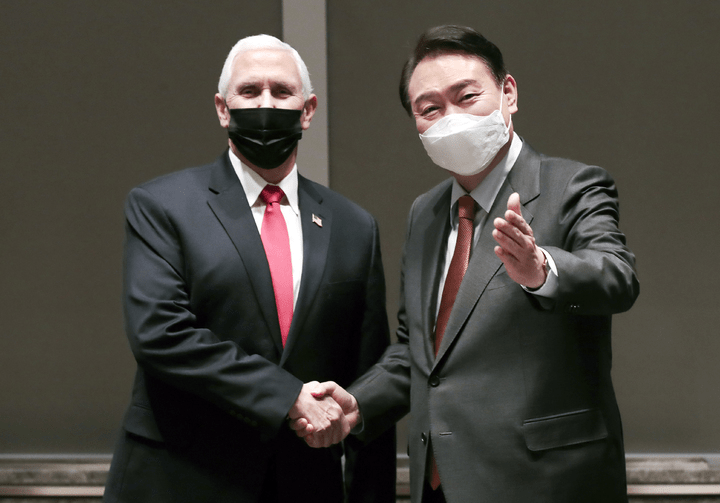
    Just weeks before South Korea’s 20th presidential election, former U.S. Vice President Mike Pence met with then-candidate Yoon Suk-yeol in Seoul—a meeting now revealed to have been brokered and funded by the Unification Church.

    According to an investigation by Newstapa, the church paid Pence $550,000 (about 700 million Korean won) to attend its “World Summit 2022 for Peace on the Korean Peninsula,” held on February 13, 2022. That same day, Pence met with Yoon at the Lotte Signiel Hotel in Jamsil, Seoul, where the summit took place.

    Screenshot of a news article from Yonhap News covering the meeting between Pence and Yoon

    At the time, Pence’s visit and his meeting with Yoon were widely reported by South Korean media as a high-profile diplomatic engagement. The meeting was held just hours after Yoon officially registered his candidacy and was viewed as a strategic move to appeal to conservative voters. Reports emphasized their discussions on the U.S.-Korea alliance and North Korea, and highlighted the fact that the two began their meeting with a prayer—an apparent nod to Pence’s and Yoon’s shared Christian beliefs.

    But what most reports omitted was the fact that Pence was in Korea as a guest of the Unification Church and that a church-affiliated interpreter was present during the meeting.

    A scene from the World Summit 2022, which happened at the same building on the same date of Pence-Yoon meeting (Image courtsey of Peacelink TV)

    A Carefully Orchestrated Encounter

    The event that brought Pence to Korea was the World Summit 2022, co-chaired by Cambodian Prime Minister Hun Sen and former UN Secretary-General Ban Ki-moon. Pence gave a keynote speech, while the opening address was delivered by Yoon Young-ho, the church’s former world headquarters director. Yoon is now under investigation for allegedly delivering bribes to First Lady Kim Keon-hee through a shamanic figure known as Jeon Seong-bae (“Geonjin Beopsa”).

    The summit served as a backdrop for Pence’s meeting with Yoon, which was attended by key members of Yoon’s campaign, including Park Jin (later Foreign Minister), Cho Tae-yong (later National Intelligence Service Director), and Kim Sung-han (later National Security Advisor). An associate of Yoon Young-ho served as interpreter.

    Though the timing of the summit and the high-profile meeting might seem coincidental, financial records suggest otherwise.
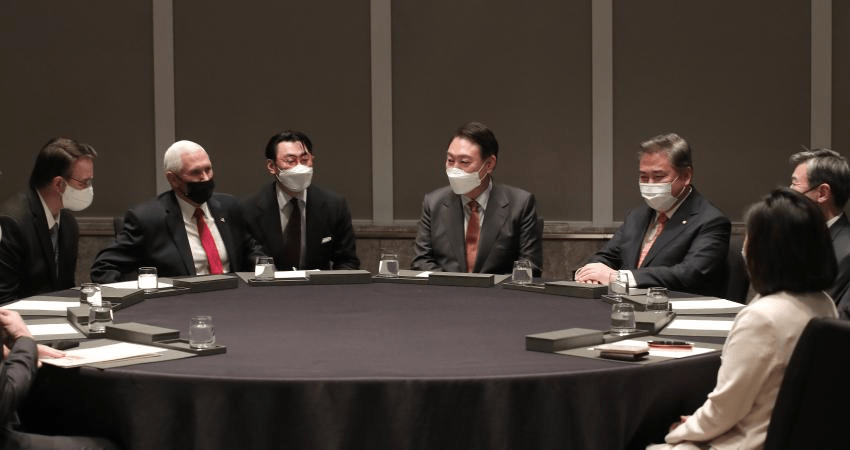
    A scene from Pence-Yoon meeting that happened concurrently with the Unification Church’s

    Unusual Payment Raises Questions

    Newstapa obtained documents Pence filed with the U.S. Office of Government Ethics (OGE) in June 2023, after declaring his presidential candidacy. The filings show that Pence received $550,000 from the “Universal Peace Federation”—a Unification Church affiliate—for his February 13 speech in Seoul.

    That figure is well above Pence’s average speaking fee of around $120,000. In fact, most of his paid appearances reported in the same filing were in that range. The unusually high fee suggests that Pence’s appearance may have served more than just ceremonial or inspirational purposes—raising questions about the church’s political motivations.

    Cambodia Connection Draws Further Scrutiny

    The story doesn’t end in 2022. Later that year, now-President Yoon and First Lady Kim Keon-hee visited Cambodia and met with Prime Minister Hun Sen, the same summit co-chair. In 2024, Hun Sen’s son and successor, Prime Minister Hun Manet, visited Seoul, where Kim made a rare public appearance at a state luncheon.

    The special counsel investigating Kim Keon-hee is now looking into whether the Unification Church lobbied her using large sums of money in connection with Cambodia’s Mekong River development projects. In June 2022, the Korean Ministry of Strategy and Finance more than doubled its economic cooperation fund for Cambodia—from $700 million to $1.5 billion.

    On July 22, the special counsel summoned Yoon Young-ho for questioning over allegations that he delivered money and lobbying requests to Kim Keon-hee via shaman Jeon Seong-bae.

    Yoon Suk-yeol (Right)and Kim Keon-hee (Left) visited Cambodia, meeting with Prime Minister of Cambodia, Hun Sen (Center)

    A Pattern Emerges

    The revelations raise serious questions about the intersection of religious influence, foreign policy, and presidential politics in South Korea. The paid visit of a former U.S. vice president, a summit staged by a controversial religious group, and the strategic timing of a candidate’s meeting with that VIP—all wrapped in coordinated media coverage—paint a picture of calculated orchestration rather than chance.

    As investigations continue, the ties among the Unification Church, the Korean presidency, and foreign players like Cambodia appear to form a complex web that could have far-reaching implications.
  • Hyundai Motor Group signs multilateral MOU to build hydrogen city in North Chungcheong Province

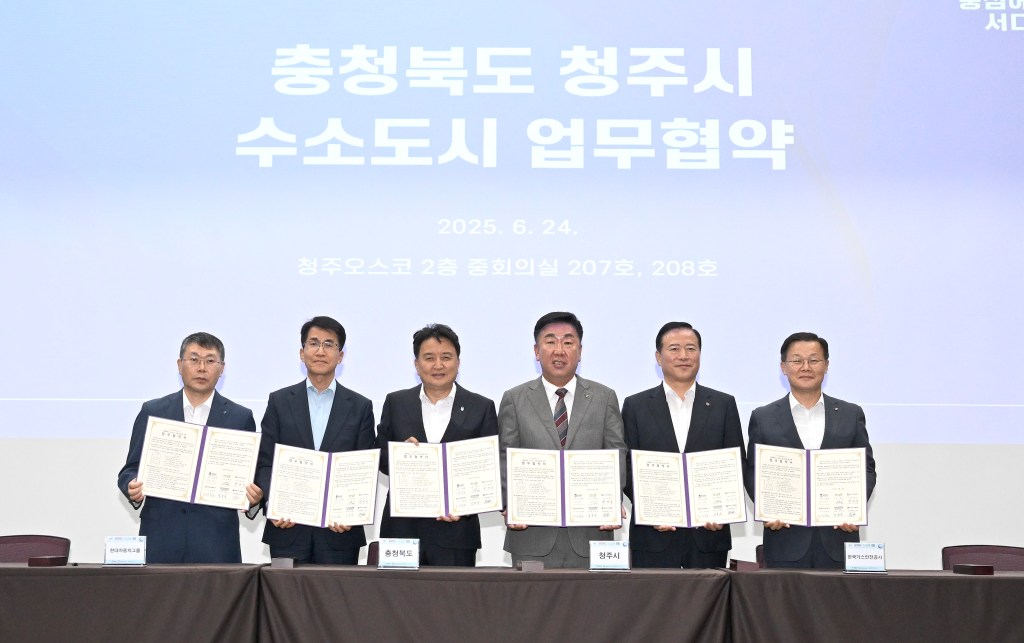
    From left: Jin Soo-nam, Acting President of Korea Gas Technology Corporation; Kim Dong-wook, Executive Vice President of Hyundai Motor Group’s Strategic Planning Division; Kim Young-hwan, Governor of North Chungcheong Province; Lee Beom-seok, Mayor of Cheongju; Park Kyung-guk, President of Korea Gas Safety Corporation; and Lee Joong-ho, Head of Korea Electric Power Corporation’s North Chungcheong Branch, pose for a commemorative photo during the MOU ceremony | Photo courtesy of Hyundai Motor Company

    Hyundai Motor Group signed a multilateral memorandum of understanding (MOU) on June 24 at OSCO in Cheongju to promote the establishment of a hydrogen city in North Chungcheong Province. The signing ceremony was attended by Kim Dong-wook, Executive Vice President of Hyundai Motor Group’s Strategic Planning Division; Kim Young-hwan, Governor of North Chungcheong Province; Lee Beom-seok, Mayor of Cheongju; Park Kyung-guk, President of Korea Gas Safety Corporation; Jin Soo-nam, Acting President of Korea Gas Technology Corporation; and Lee Joong-ho, Head of Korea Electric Power Corporation’s North Chungcheong Branch.

    The hydrogen city initiative is a large-scale project aimed at transforming Cheongju into an eco-friendly smart city powered by hydrogen energy. It aligns with the South Korean government’s Carbon Neutral 2050 goal and policies to boost the hydrogen economy. The project focuses on establishing a hydrogen ecosystem throughout the central inland region of the country.

    Under the agreement, Hyundai Motor Group plans to quadruple the capacity of its clean hydrogen production facility in Cheongju, which uses biogas. Once expanded, the facility will be capable of producing 2,000 kilograms of clean hydrogen daily, ensuring stable local supply.

    Hyundai will also support the expansion of hydrogen refueling infrastructure and the introduction of hydrogen mobility solutions in the region.

    The North Chungcheong provincial government and Cheongju city will provide active support in terms of budgeting and regulatory approvals necessary for the hydrogen city initiative.

    Korea Gas Safety Corporation will oversee the establishment of a Hydrogen Gas Safety Hub Center and facilitate training programs for specialized personnel, while Korea Gas Technology Corporation will be responsible for project progress and performance management. Korea Electric Power Corporation will build smart power infrastructure to support the hydrogen city.

    Hyundai Motor Group expects this initiative to energize the regional hydrogen economy and accelerate the transition to a hydrogen-powered society.

    At the “North Chungcheong Hydrogen Economy Forum” held following the MOU ceremony, Hyundai Motor Group presented the status and future plans of its global hydrogen initiatives centered on HTWO, the company’s hydrogen brand and business platform.

    The group emphasized that by spearheading the first hydrogen city project in North Chungcheong Province, it aims to revitalize the local hydrogen economy and contribute to national carbon neutrality. Hyundai also reaffirmed its commitment to expanding the full hydrogen value chain—from production to utilization—through strategic partnerships and global investments.

    The group is also pursuing a range of hydrogen ecosystem projects, including a hydrogen production demonstration project at the Food Waste Bio Center in Chungju, a circular hydrogen project with Paju City and the Korea Institute of Advanced Technology to build a mini hydrogen city, and a resource-circulating hydrogen solution project in West Java, Indonesia, where the group operates major production facilities.

  • Revenue Plunges 80% After Yoon’s Martial Law: “30 Years of Work on the Brink” Cries Erupt

    “Customers Vanish After Emergency Martial Law”

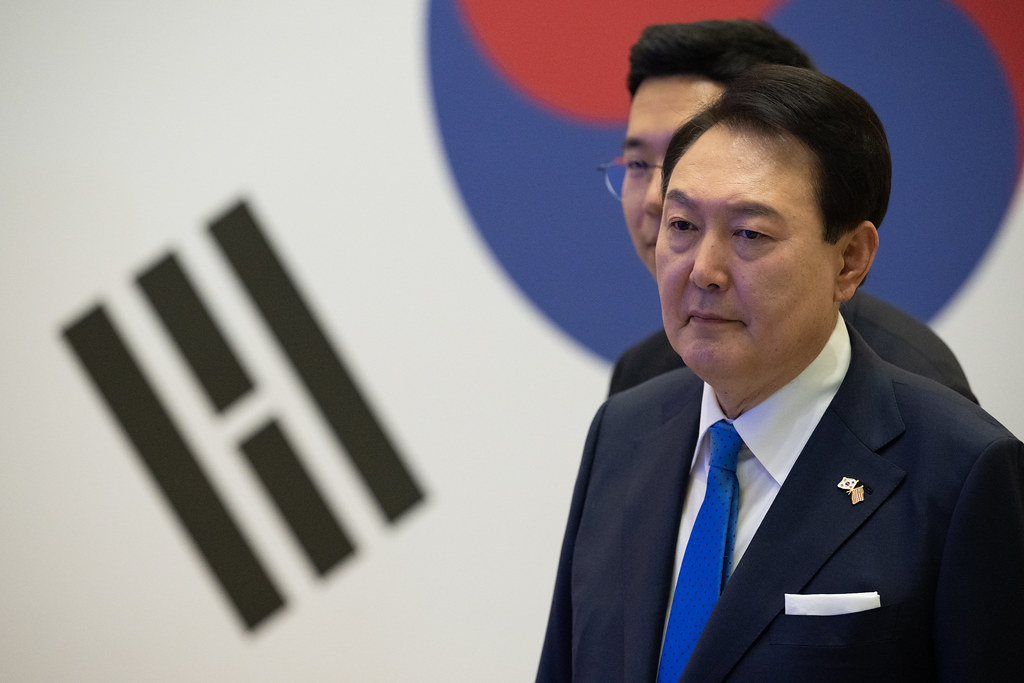
    Former President of South Korea, Yoon Suk Yeol, at GSFC on April 25, 2023 by NASA HQ PHOTO is licensed under CC-BY-NC-ND 2.0

    Tears of Seoul’s Underground Shopping Malls

    Seoul’s underground shopping malls face their biggest crisis due to the worsening economic downturn following the December 3rd emergency martial law last year. Merchants lament that the current situation is more difficult than during the COVID-19 pandemic in 2020.
    According to the Seoul Facilities Corporation and the National Association of Underground Shopping Mall Merchants on the 29th, overdue rental fees for 349 stores directly managed by the corporation in underground shopping malls amounted to 279 million KRW from January to April, more than double last year’s total overdue amount of 120 million KRW. As of the end of April, vacancies nearly doubled to 30 stores from 17 at the end of last year.
    Seoul’s underground shopping malls are facing their worst crisis due to the deepening recession triggered by emergency martial law. On the 26th, Gangnam Station underground shopping mall was deserted, with many stores closed.
    The scale of overdue payments and vacancies in underground shopping malls managed by entrusted corporations, not directly by the Seoul Facilities Corporation, is reportedly much larger than in directly managed malls. Stores managed by entrusted corporations account for 92.9% of Seoul’s 2,788 underground shopping mall stores. Merchants have begun collective action, saying, “They cannot endure it anymore.” Today, the association held a rally in front of Seoul City Hall, with about 350 merchants participating, urging the Seoul Metropolitan Government to prepare countermeasures.
    Daily Revenue Plunges 80% After Martial Law… “Working Two or Three Jobs to Pay Rent” 2,788 Underground Shopping Malls on the Brink of Collapse
    On the evening of the 28th, at 7 PM, the Yeongdeungpo Station underground shopping mall in Seoul, where about 80 small shops selling clothes and accessories are concentrated, most stores began to close, even though it was early evening. Lee Hye-young (66), who has run a clothing store here for 30 years, sighed, “Before the emergency martial law on December 3rd last year, daily sales were 400,000 to 500,000 KRW, but now it is barely one-fifth of that.” On this day, Ms. Lee sold three pieces of clothing (82,000 KRW). She also defaulted on her monthly rent of 3.13 million KRW to the Seoul Facilities Corporation and recently received a contract termination notice.
    Merchants in Seoul’s underground shopping malls are on the verge of collapse due to the economic downturn triggered by last year’s December 3rd emergency martial law. This is because consumer sentiment has shrunk and the floating population has drastically decreased, from the emergency martial law to the presidential impeachment and election period. These merchants collectively state that support measures from the Seoul Metropolitan Government, such as rent reduction, are desperately needed, just like during the COVID-19 pandemic.

    Revenue Down, Rent Stays the Same
    Merchants, unable to endure the deepening recession after emergency martial law, took to the streets. On the morning of the 29th, about 350 underground shopping mall merchants (police estimate) gathered in front of Seoul City Hall, holding placards that read ‘Guarantee Right to Survival’ and urging support from the Seoul Metropolitan Government.
    Park Jung-hoon (42), who attended today’s rally, said, “After running a contact lens store in Jamsil Station underground shopping mall for 8 years, customers decreased by over 20% in just one month after the December 3rd emergency martial law.” He expressed frustration, saying, “There is not a single support measure from the Seoul Metropolitan Government that considers this situation.”
    Lee Min-woo (49), who operates an underwear specialty store in Gangnam Station underground shopping mall, said, “I have been in business for 15 years, but this is the worst.” Mr. Lee said, “The underwear sales business has its peak season from December to March, including Valentine’s Day and White Day.” He added, “After the emergency martial law, large-scale rallies continued in Seocho-dong, so the first quarter was virtually like opening for business and then closing.”
    Merchants struggling to pay rent are firing employees and becoming “solo owners” or entering the side job market. Shin Sung-hee, head of the Yeongdeungpo Station underground shopping mall merchants’ association, said, “The rental burden is heavy, but monthly sales are not coming in, so the number of merchants looking for part-time work such as delivery and cleaning has increased sharply.” She also relayed, “At a nearby shoe store, the owner’s son works part-time for a few hours a day, and his elderly mother just sits outside, making sure the goods don’t get damaged.” Cases of completely returning stores are also rampant. According to the Seoul Facilities Corporation, the number of returned stores in directly managed underground shopping malls this year is 13, significantly exceeding last year’s 12.

    “Rent Reduction is a Necessity, Not an Option”
    Merchants emphasize that rent reduction is not an option but a necessity in the current situation. Merchants at Gangnam Station underground shopping mall held a rally demanding rent reduction in December last year, about a week after declaring emergency martial law. Kim Jin-won, head of the Gangnam Station Underground Shopping Mall Merchants Association, said, “Gangnam Station has the highest rent among Seoul’s underground shopping malls.” He added, “Sales have plummeted, but everyone is struggling to earn the same rent.”
    These merchants already submitted a petition to Seoul Mayor Oh Se-hoon in the name of the National Association of Underground Shopping Mall Merchants last January. In the petition, the association appealed, “The sudden emergency martial law and impeachment situation that occurred in the underground shopping malls, which were waiting for commercial area recovery after the COVID-19 disaster, are freezing the commercial area again and causing great damage.” They pleaded, “Measures are needed to reduce rent until the end of this year.”
    In this situation, merchants were strongly protesting when news broke that the Seoul Metropolitan Government was promoting a plan to change the bidding method to individual store units starting this year. Merchants criticized the Seoul Metropolitan Government, questioning whether it properly understands the reality of underground shopping malls, as it seems to be raising prices through competitive bidding instead of reducing rent.

    Source: 계엄 후 매출 80% 급감…”30년 일 접을 판” 비명 쏟아진 곳 (Korea Economic Times)